4G.ro
Guides to Romania’s mobile networks: roaming, eSIM, number porting, prepaid cards, and plans, with prices checked against official sources.
About the project
4G.ro answers the questions anyone with a phone asks: how much a week in Turkey costs, how to move your number to another operator, how to activate an eSIM, why the signal is weak at home. The answers are given for each operator (Orange, YOXO, Vodafone, Vodafone EASY, and Digi), based on their official pages, on ANCOM (the National Authority for Management and Regulation in Communications, Romania’s telecom regulator), and on EU rules. The site does not sell plans, prepaid cards, or phones, and it does not use the operators’ logos.
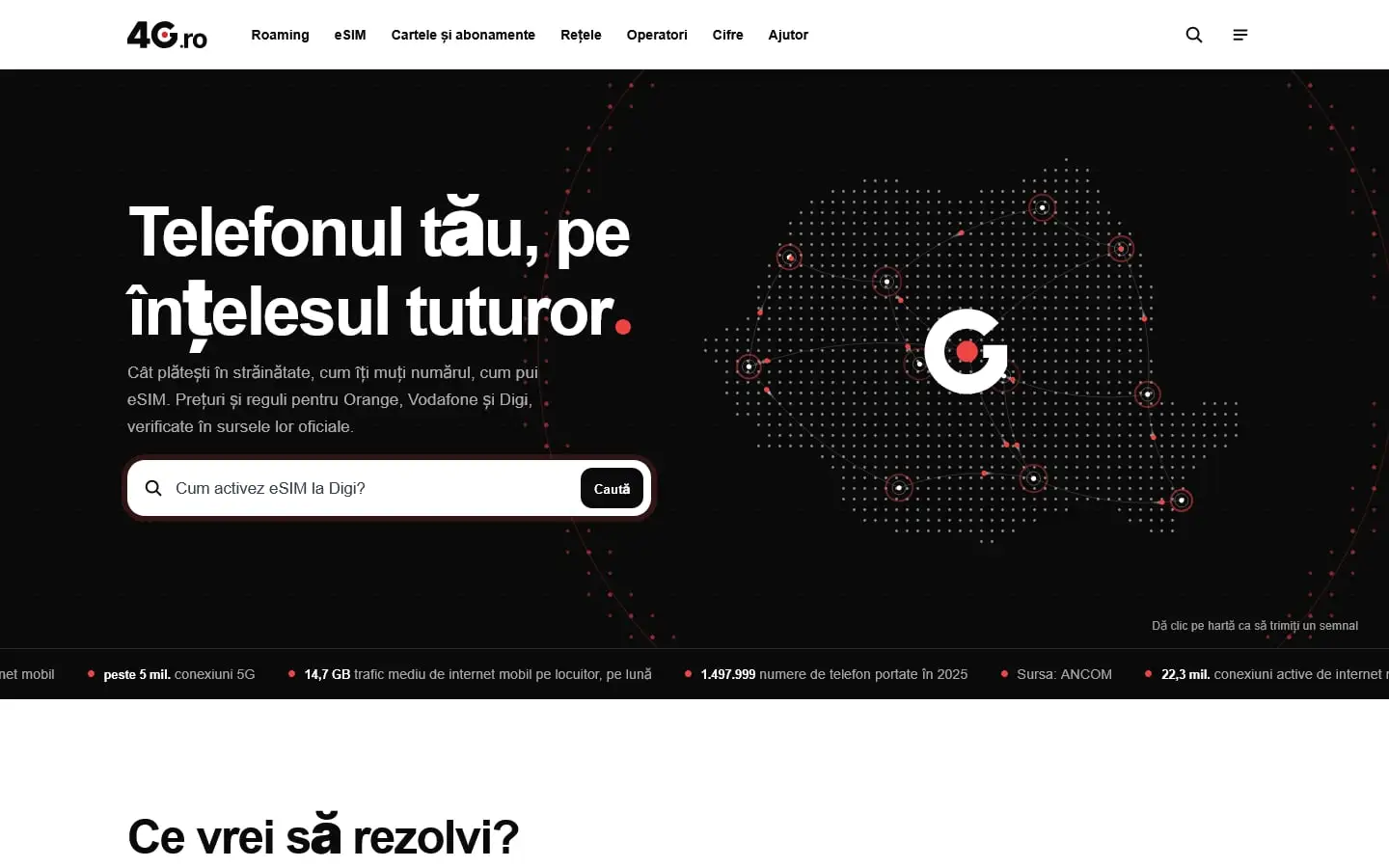
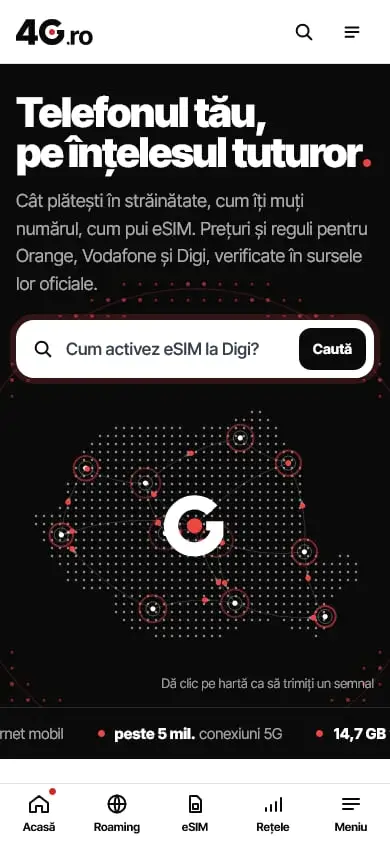
The home page opens with a search box and a map of Romania drawn in dots, linked to each other like a network: tap the map and you send a signal. Below, a section that asks what you want to solve organizes the site by situation: going abroad, switching operators, getting an eSIM, a weak signal at home, or being a former Telekom customer. In the network picker, you choose your operator and see right away what you can do on its network: eSIM, Wi-Fi calling, a smartwatch with the same number, 5G, and what a week in Turkey costs.
For roaming, the site applies the same usage to every operator: 7 days, 3 GB of data, 5 minutes of calls to Romania, and 5 minutes of incoming calls. You pick the country, from Turkey and the UK to Serbia, Moldova, and Ukraine, see the cost with each operator, and then what happens if you forget to activate the roaming option. Number porting is shown as a four-step path, from the day you apply to the compensation you can claim if it is late. In a short trivia section, six questions reveal their answers only when tapped, for example, what happens to your number if you let your prepaid card expire.
Every guide states openly how it knows what it says, with a label showing whether the information comes from official sources, was tested, or uses ANCOM data, plus the date it was checked. Sources are linked, and when two official sources contradict each other, the page shows both. Pages on how the site works, its editorial policy, and how it is funded explain how topics are chosen, how often prices and codes are rechecked, and what rules ads and affiliate links will follow if they ever appear. Corrections are logged on a separate page, and in the figures section, the number portability barometer uses ANCOM data to show how many numbers are ported each month and which operators receive them.
The logo was designed for this site: “4G” with a red dot at the core of the letter G, like a signal, and “.ro” after it. On the dark background of the home page, the white G sits at the center of the map, and the red dot reappears at the end of headings and in the row of figures that scrolls beneath the map. For Google, every guide has its own URL in its section, from Roaming and eSIM to Networks and Operators, and a title that says exactly what you will learn, for example, a title on what roaming in Turkey costs with Orange, YOXO, Vodafone, EASY, and Digi.